
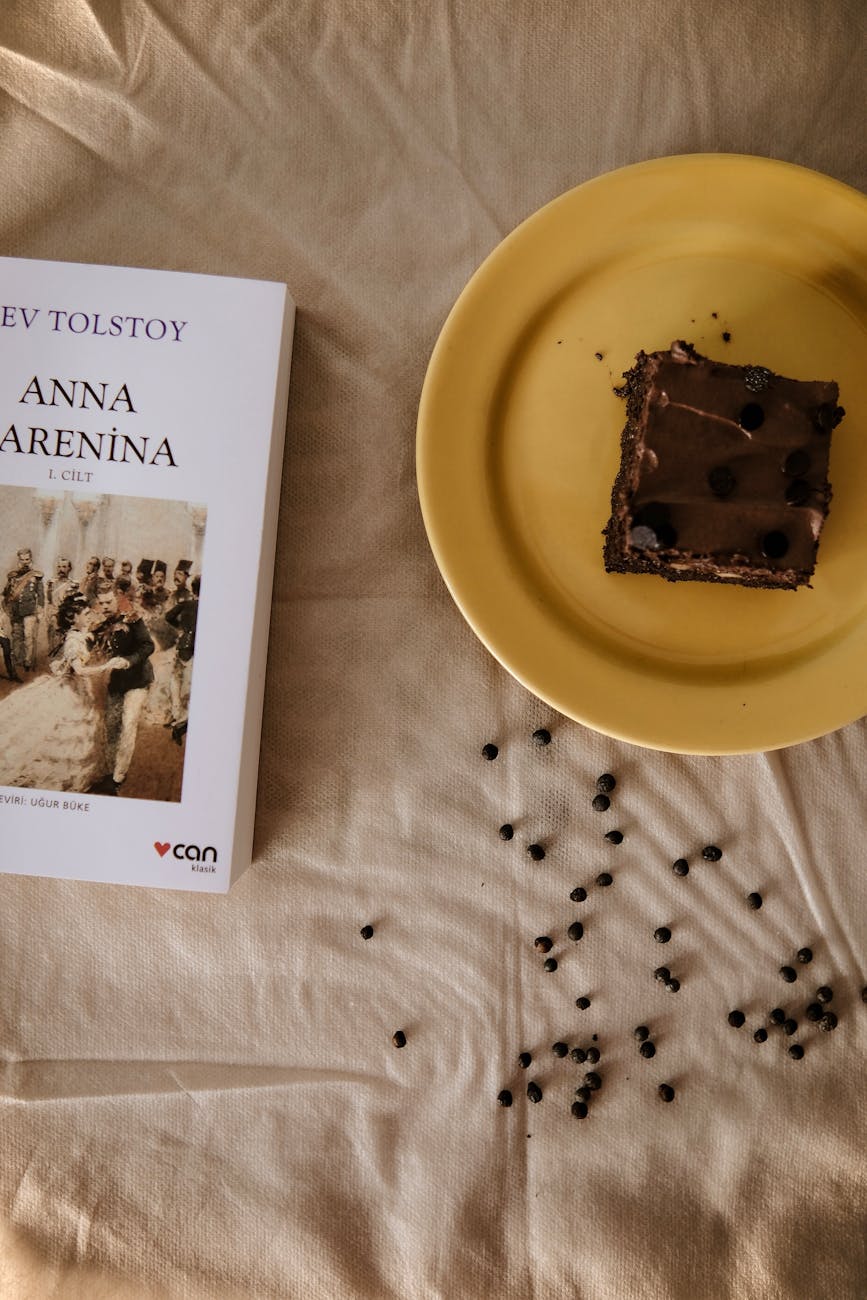
Introduction
It is spoiler-free when it comes to specific events, but I will discuss many ideas within the book.
The main story is about an affair between two Russian aristocrats. While the young man is in the military, the lady, Anna, has an established husband.
In parallel, and often less talked about, there is Constantin Lenin, who is a rich owner of land. He is a complex character who is longing for a reason to live.
Context: My experience
The main story was not a smooth read for me, which made the read more of a 900-page-long dream.
In fact, it took me 10 years to read it from cover to cover, although I did a lot of skip reading in the beginning.
It is surprising to me because I love Tolstoy’s writing. It is delightful, but I kept wondering, “What is the relevance of some of these classics for our modern mind?”
In general, you cannot pay me to be interested in a story about an affair. Not today, not ever. It is not that I’m judgmental, nor is it about religious smugness.
Everyone believes that his or her story of unfaithfulness is original, unique, and justified when, in fact, it is very similar to other people’s and as mechanical.
But I was captivated by Constantin Lenin.
The Treatment of religion within the book
Leo Tolstoy is a Russian writer, but most importantly, he is a Christian writer. His aim was to talk about an affair and to be unjudgmental about it.
You cannot get out of this read without feeling that you read a retelling of some deep Christian themes (temptation, the fall, and love that saves souls).
Lenin’s story is where most of the Christian themes unfold:
He is a lonely, deeply troubled man who has “lost” his youth’s faith in God.
His main question is one that parallels an eternal human question: “Why are we here?” and “What is the meaning of life?”
At this time, Darwin’s book about natural selection had been published, and many young students were enthralled by it.
The millennials’ long debate was finally put to an end, and reason, as pushed by many philosophers, had won: God was not necessary anymore.
And still, he was miserable.
Lenin represents the common man, or even Adam, after the fall.
As God intended for man on earth, he works the land for his subsistence.
In fact, to his entourage’s surprise and mockery, Lenin plows untiringly alongside his employees.
He possesses and commands his animals (cattle, horses, and so on).
He lives simply, with no one to criticize him for his lack of faith, but feels incomplete and deeply tortured. What gives him momentary clarity is finding a wife and feeling like they merged into one being (again, a religious command).
And the doubt about the purpose of life and God’s existence kept on torturing him.
Criticisms
As religious people or simply believers in something like a God or a higher being, we may not always understand the atheist’s or the unreligious’ stance.
While faith can be a spectrum, something really “alive,” that evolves and transforms itself while we go through life, we forget that for each edge of the spectrum, some people have a clearer and less malleable thought on what they believe (or don’t believe) in.
Tolstoy’s religious theses are not only biased; they seem incomplete. While his first goal was to write about an affair (typically, a sin) without judgment, his education reared its head early, although very discreetly.
Through different stages, he tried his best to stay out of judgment. But when it comes to deciding why one must believe, his philosophy falls short.
Within the book, he cites many (generally analytical) philosophers without respecting faithfully the philosophical method. This makes his conclusions lack a strong basis.
He starts with arguments and reasons, then promptly falls into a more phenomenological stance instead of admitting that reason is a process and does not lead to a single truth.
At least, his arguments do not lead to where he wishes to go (a clear proof of God’s necessary existence). So, toward the end, he slightly changed his stance to a more “phenomenological” view, meaning that way before Camus talked about embracing the moment to give meaning to life, Tolstoy had a similar idea.
Through Lenin, Tolstoy offers that one must follow and honor his intuition (instead of his reasoning mind) that God exists and that life is worth living if we wish to preserve one’s soul.
His era of questioning and great change must have tortured Tolstoy’s mind, just like Lenin’s.

 Somali Tales
Leave a comment